

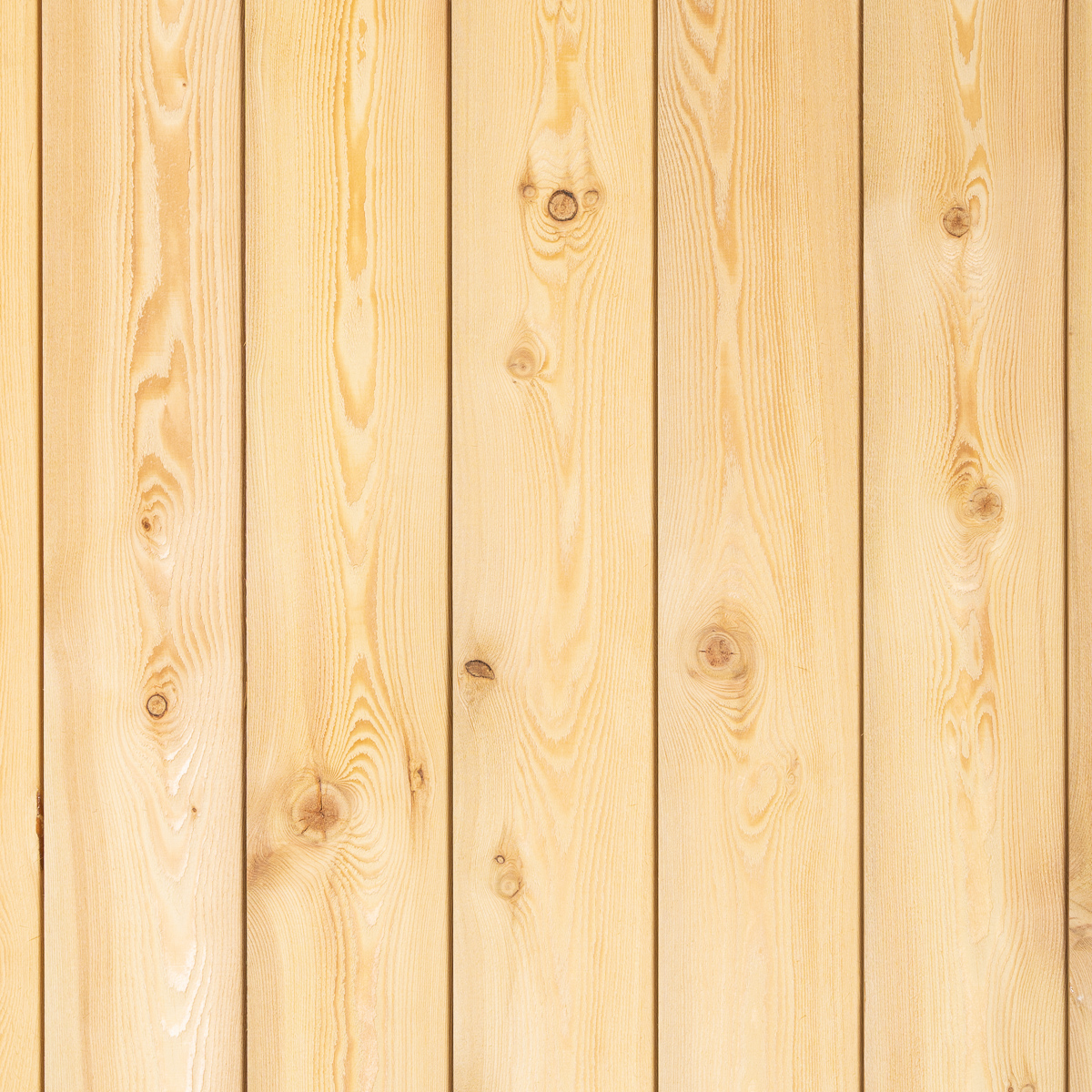
| Length | Available | |
|---|---|---|
| 4.00 m | 1,080.00 m |
Treatment Instructions for Siberian Larch Exterior Cladding
Siberian larch does not require surface treatment for outdoor use, as it can remain decay-free for approximately 50–60 years when installed off the ground. Due to its natural decay resistance, dense and resinous structure, we do not recommend any surface treatment. Left untreated, it will naturally turn silvery-gray from rain and UV exposure within 2–3 years.
Advantages of larch include low maintenance for wall surfaces. Although the initial material cost is higher, the life-cycle cost is lower over time because maintenance painting is unnecessary, compared to treated Nordic spruce cladding.
Optional Gray Aging:
- Larch can be artificially gray-aged using ferrous sulfate (iron vitriol).
- Apply a 1:10 ferrous sulfate–water mixture by brush or spray, two coats.
- Gray color develops with exposure to sunlight, reaching the final shade within 7–14 days.
Note on Painting:
- Paint absorbs poorly and slowly into dense larch.
- Maintenance intervals are significantly shorter than for Nordic spruce.
- For a colored finish with guaranteed maintenance intervals, using spruce instead of larch is recommended.
Product information
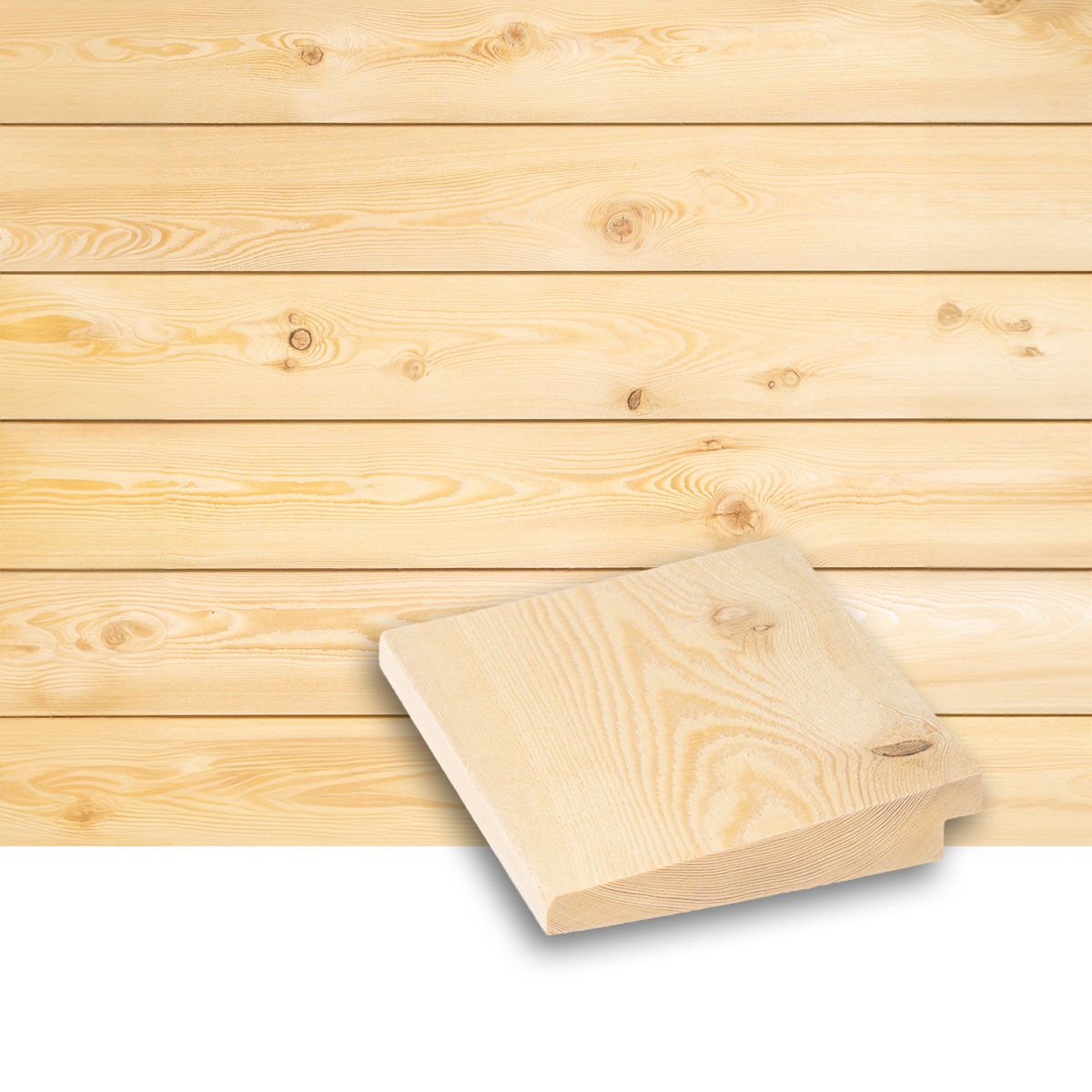
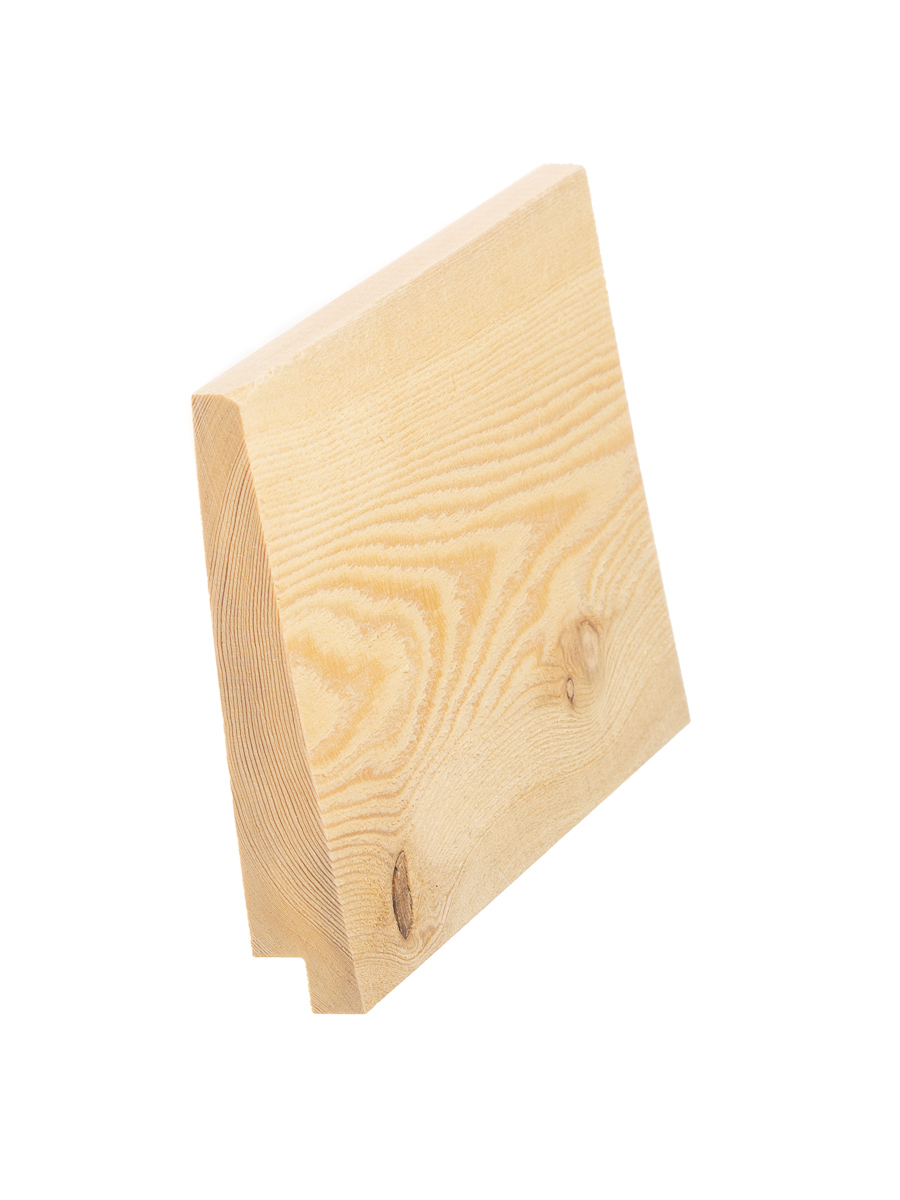
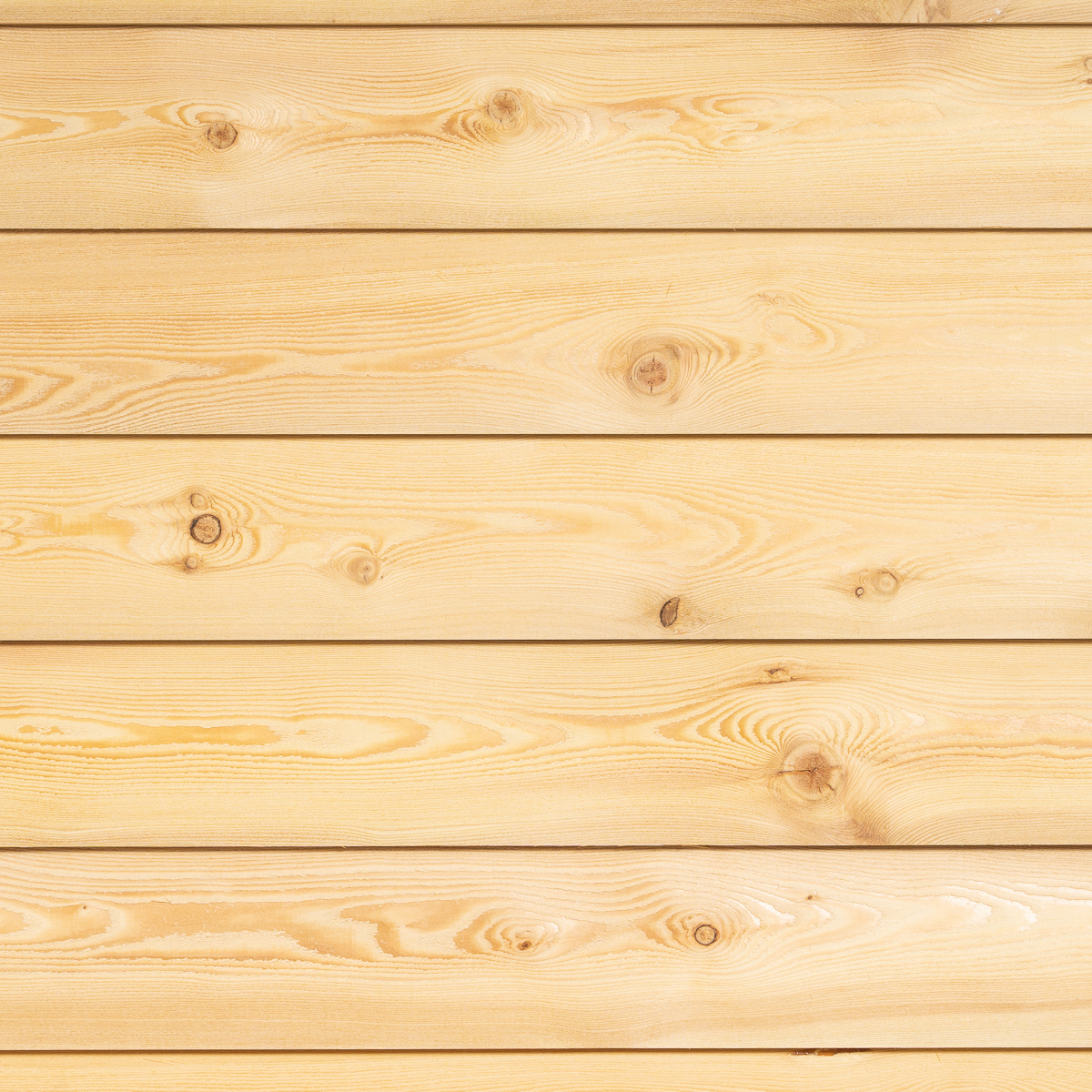
| Tuotenimi | ULKOVERHOUS LEHTIKUUSI 28/15x120 UYL VINOVUORI |
| Tuotenumero | 4040 |
| Alkuperämaa | Suomi |
| Toimitusaika | huomenna, kun tuotetta varastossa |
| Saatavuus | Tuote poistuu valikoimasta |
Product measurements
| Vahvuus (mm) | 21 |
| Leveys (mm) | 120 |
| Paino (kg/myyntiyksikkö) | 1,160 |
| Neliömenekki (m/m²) | 9,09 |
| Hyötyleveys (mm) | 108 |
| Pakkauskoko (kpl/pkt) | 1 |
Product features
| Puulaji | Siperian lehtikuusi |
| Pintakäsittely | Ei käsitelty |
| Palokäyttäytyminen | D-s2, d0 |
Sustainability
| Hiilijalanjälki (CO2e kg/jm) | 0,11 |
| Hiilikädenjälki (CO2e kg/jm) | -1,91 |
| CE-merkintä | Ei |
Minimum order size
Please note that we deliver our products in bundles. Bundle size is indicated together with stock information on top right corner.
Surface treatment brings out the best in wood
The right surface treatment finishes the wood for exactly the purpose it's meant for. It protects the wood, extends its life cycle and gives it a color that suits the look of your home or building.
Not all wood needs treatment, but surface treatment lets you highlight different qualities of the wood. When the wood is treated during manufacturing, it's ready to install right away. This makes tight construction and renovation schedules easier to manage.
Why choose industrial surface treatment?
We paint and treat the wood on our own industrial paintline right after planing. At that point, the wood surface is open and the paint or treatment soaks in effectively. The temperature and humidity on our paintline stay constant, so the paint spreads evenly and dries properly. The result lasts longer than paint applied on site at the mercy of the weather.
- You save time. Industrially treated wood is ready to install, so there's no need to wait for good painting weather on site.
- You get an even finish. In controlled conditions, every board and panel receives the same treatment.
- The wood is protected during construction. The surface treatment protects the wood from rain and sunlight from the moment it's installed.
Surface treatment options
The right surface treatment depends on how the wood will be used and the look you're after.
- Opaque paint covers the grain of the wood and gives the surface an even, finished color. Outdoors, opaque paint protects the wood for a long time.
- Semi-transparent treatment gives the wood a color tone while letting its natural grain show through.
- Sauna protection treatment helps wooden sauna surfaces withstand high temperatures and humidity. It also makes the surface easier to keep clean.
- Fire-retardant treatment gives the wood surface a fire classification of B-s1, d0. This is the highest class available for wood construction products, so fire-retardant wood can also be used in buildings with strict fire safety requirements.
Good to know about wood species
Wood species differ from one another, and the need for treatment depends on both the species and how the wood is used.
- Spruce always needs a protective surface treatment outdoors. Spruce cladding is painted with either semi-transparent or opaque paint.
- Douglas fir and larch are naturally rot-resistant and dense, so they don't need surface treatment outdoors. Left untreated, they turn a beautiful silvery gray over time.
- Thermally modified wood has excellent dimensional stability thanks to thermal modification.
- For wood used in saunas, we recommend sauna protection treatment regardless of the species.
Responsibly treated
We use water-based paints and treatments from well-known manufacturers. Water-based products contain fewer solvents than solvent-based ones, so they put less strain on the environment and indoor air.
DID YOU KNOW? Because we want to operate as sustainably as possible, each batch we treat must be at least 500 meters. This way, we don't waste raw materials, and our operations stay efficient.
Ask us more
We have long experience in wood surface treatment, and we're happy to help you find the right treatment for your project. Contact our sales team to learn more about the options.
Installation
Our cladding boards don't need any surface treatment, as the wood is naturally weather-resistant. Over time, the cladding turns a beautiful silvery gray.
Before installation
Check the moisture content. Wood shrinks as it dries, so the moisture content of the cladding boards must be below 20% at the time of installation.
Choose either vertical or horizontal cladding. A façade looks calm and balanced when each wall is clad in one direction only. Combining vertical and horizontal cladding usually calls for a lot of trim and tricky details. Choose a solution that suits the building and its surroundings, and keep the overall look simple and clean.
How to make your cladding last
- Use cladding boards that are thick enough. We recommend a thickness of 28 mm.
- Avoid joints, or use end-matched boards.
- Shape the bottom edge of the cladding into a drip edge so that water runs off the structure.
- Leave a ventilation gap of about 22–25 mm behind the cladding, open all the way from bottom to top.
- Design the plinth so that the bottom edge of the cladding is at least 300 mm above ground level.
- Make sure the window flashings and trim or cladding direct water away from the wall.
- Make sure the gutters and downspouts work properly.
- Make the eaves at least 300 mm wide, preferably 600 mm.
Good to know: Our cladding boards contain heartwood, and the profile determines which way round they are installed. This means that in some boards the heart side faces out, and in others it faces in. Boards containing heartwood may develop small cracks over time. This is a natural characteristic of wood and does not affect the durability of the cladding.
Fastening
Battens
- Horizontal cladding: Install the battens vertically and fasten them securely through the wind barrier to the studs of the exterior wall.
- Vertical cladding: Install the battens horizontally and fasten them securely to the studs through the spacer battens and the wind barrier. The spacer battens let air circulate in the ventilation gap.
Fastening the cladding boards
You can fasten the cladding boards with nails, staples or screws. Whichever method you choose, space the fastening points about 600 mm apart.
The fastening method depends on the board's tongue:
- Full tongue-and-groove boards can be fastened through the tongue.
- Half-tongue boards must always be fastened through the face. This keeps the board from lifting off the tongue as it dries.
With nails
- Use hot-dip galvanized ring-shank nails at least 75 mm long. You can also use stainless steel nails.
- Fasten the board at each fastening point with two nails, about 20–25 mm from the edge of the board.
Douglas fir and larch are rich in natural extractives, which can react with hot-dip galvanized nails and leave dark streaks on the wood surface. As the cladding turns gray, these streaks become hard to notice. If you want to avoid them altogether, choose stainless steel nails.
With staples
Staples are suitable for full tongue-and-groove boards only.
- Use stainless steel staples.
- Fasten the staples through the tongue of the board.
- Choose a staple length where the part that goes into the batten is at least twice as long as the part that passes through the cladding board.
With screws
- Use countersunk screws made of A2 stainless steel.
- Choose the screw size according to the board thickness. For our recommended 28 mm cladding board, a 5 x 70 mm screw is a good fit.
- Pre-drill the screw holes, especially at the ends of the boards. This keeps the boards from cracking.
If you use a pneumatic nailer
Use a nailer designed for exterior cladding and hot-dip halfhead nails. With a nailer, you can adjust the nailing depth as you work. Make sure the nails don't sink in too deep and break the wood surface. The nail head should sit flush with the surface, as a recessed head lets rainwater soak into the wood.
Surface treatment of exterior cladding
Douglas fir and larch cladding doesn't need any surface treatment. Both species are naturally rot-resistant and dense, so they withstand Finnish weather conditions without paint or oil.
Turning gray
Untreated cladding turns a beautiful silvery gray from rain and the sun's UV radiation. Depending on conditions, this takes about 2–3 years. Under the eaves and in other sheltered spots, the wood turns gray more slowly, so the color may be uneven at first. The difference evens out over time.
If you want to influence the color
- Slowing down the graying: You can slow down the graying by treating the cladding with a clear or tinted wood oil. Oil soaks into dense wood slowly, and the treatment must be repeated much more often than on spruce, for example. Without repeated treatments, the natural graying of the wood can't be prevented.
- Speeding up the graying: Iron sulfate (green vitriol) makes the cladding turn gray quickly and evenly. Brush or spray a mixture of iron sulfate and water in a ratio of 1:10 onto the surface twice. The graying starts once the surface is exposed to daylight, and the final color develops in about 7–14 days.
Maintenance
Untreated cladding is almost maintenance-free. When you keep the façade clean and the structures in good condition, the cladding lasts for decades.
Check the façade once a year
- Make sure the gutters and downspouts are clean and working.
- Check that the window flashings and trim or cladding direct water away from the wall.
- Make sure the ventilation gap is open and air can circulate behind the cladding.
- Keep plants, snow and stored items away from the wall so that the cladding can dry out.
- Check that the fasteners are in place, and refasten any loose boards.
Clean when needed
- Brush off dust and dirt with a soft brush.
- Wash dirty areas with water and an all-purpose cleaner, using a soft brush. Brush along the grain of the wood.
- Rinse with clean water.
- Avoid cleaning products that contain chlorine, as chlorine can soak into the wood.
- Let the wall dry thoroughly.
Good to know
Over time, sunlight and changes in moisture and temperature may cause small cracks in the wood surface. This is a natural characteristic of wood and does not affect the durability of the cladding.
Lauta.fi delivers product sample pieces to both consumer customers and professionals, such as architects, interior architects and designers, construction industry and procurement professionals.
If you are interested in ordering one or more sample pieces, please contact our sales department via email lauta@lauta.fi or phone +358 3 3123 6000 (On weekdays 8-16).